
Provisioning for Long Passages: Food, Water and the Maths Behind Both
Provisioning a sailboat for a long offshore passage is equal parts arithmetic and instinct. Get the numbers wrong and you arrive exhausted, grumpy, or worse. Get them right and the voyage becomes a moving feast that keeps the crew healthy and the watch system humming. Every gram and millilitre counts when the nearest shop is a thousand miles away.
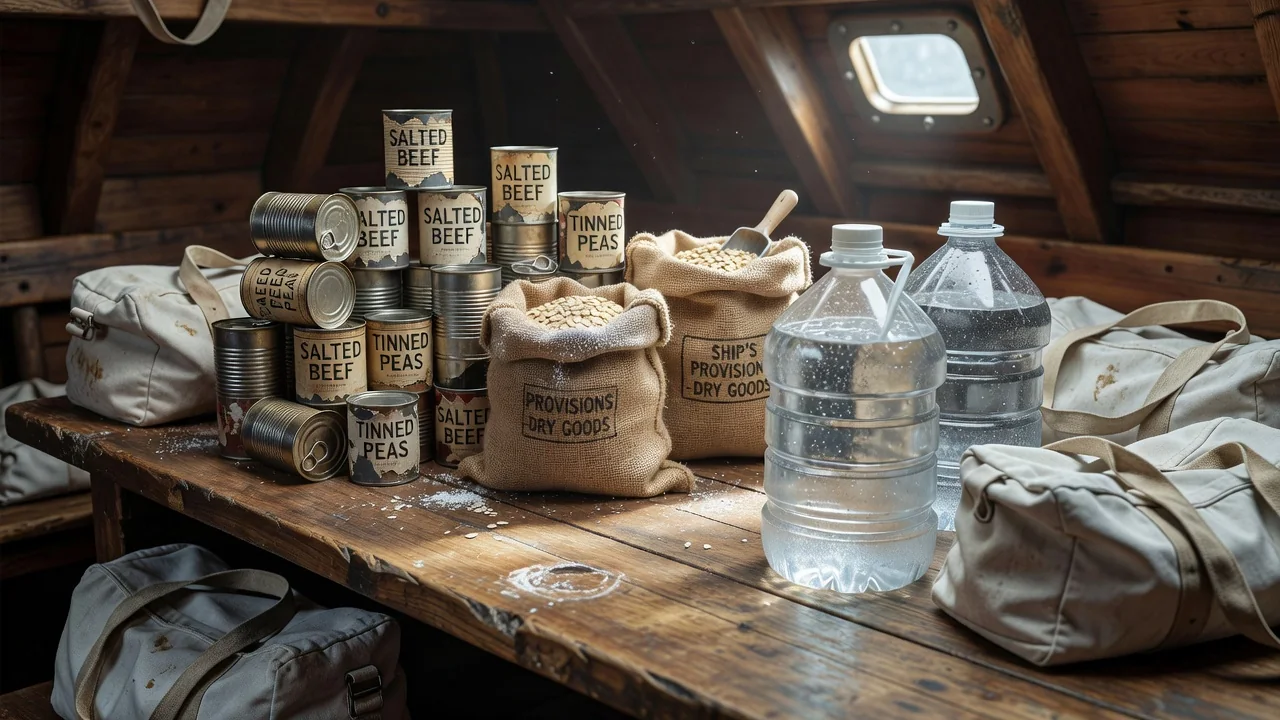
Start with the basics: calories and water. A resting adult needs roughly 2,000 kcal per day; an active sailor on passage burns closer to 2,800–3,200 depending on weather and workload. Add a 50 percent safety margin and you are looking at 4,200–4,800 kcal per person per day. For a crew of four on a 28-day Atlantic crossing that means 470,000–540,000 kcal total. Translate that into real food: 35 kg of rice, 20 kg of pasta, 15 kg of nuts and dried fruit, plus tinned protein and a few luxuries. Water is simpler but heavier. Plan on 4 litres per person per day for drinking and minimal cooking. With the same margin you need 168 litres per person for four weeks. A 600-litre tank suddenly looks modest once you factor in spillage and emergency reserves.
Watermaker versus Tankage: The Eternal Trade-off
Installing a watermaker frees up space and weight but adds complexity, power draw and maintenance. A 12-volt 20-litre-per-hour unit can keep four people comfortable if it runs two hours daily, yet it consumes 40–50 amp-hours and needs regular membrane flushing. Many passagemakers still prefer oversized tanks plus jerrycans for redundancy. A 1,000-litre total capacity gives peace of mind even if the watermaker fails on day three. The sweet spot is often a modest watermaker paired with 700–800 litres of tankage, allowing the crew to run the system only in calm conditions when solar and wind input is highest.
Food That Survives the Southern Ocean
Without refrigeration, your menu narrows to items that laugh at salt air and rolling decks. Vacuum-packed cured meats, hard cheeses sealed in wax, powdered eggs, UHT milk, and endless varieties of tinned fish form the backbone. Dehydrated meals rehydrated with boiling water become lifesavers in the small hours. Freeze-dried fruit and vegetables retain surprising flavour and weight almost nothing. Pasta, rice, couscous and lentils store indefinitely if kept dry. Avoid fresh bread after day five; instead pack flour and baking powder for quick soda bread that can be cooked in a lidded frying pan even when the boat is heeled at thirty degrees.
- Store heavy tins low and forward to keep the centre of gravity happy
- Label every locker with waterproof tape so the off-watch can find dinner without turning on the main lights
- Rotate stock every six months; nothing kills morale faster than rancid oil
- Pack a separate “happy box” of chocolate, nuts and single-serve spirits for midnight rewards
Meal Planning for Rough Weather and Morale
In a gale the galley becomes a dangerous place. Pre-cook and vacuum-seal one-pot meals that can be reheated in a thermos or eaten cold if necessary. Think chilli, curry, or lentil stew. Breakfast should be idiot-proof: overnight oats in a sealed jar or energy bars. Dinner shifts to anything that can be eaten with one hand while the other grips a handrail. Morale food is not a luxury; it is a safety item. A shared bar of dark chocolate at the change of watch can reset a tired crew faster than any pep talk. Small rituals—Sunday cake baked in the pressure cooker, a sip of rum on Fridays—keep the human machinery running when the physical boat is being tested.
| Item | Per Person/Day | 28 Days / 4 Crew | Notes |
|---|---|---|---|
| Calories target | 4,500 kcal | 504,000 kcal | Includes 50% margin |
| Drinking & cooking water | 4 L | 672 L | Plus emergency 100 L |
| Dried fruit & nuts | 150 g | 17 kg | High-energy snacks |
| Tinned fish or meat | 200 g | 22.4 kg | Protein backbone |
| Chocolate (morale) | 40 g | 4.5 kg | Non-negotiable |
Galley organisation turns chaos into calm. Everything has a home, and every home is labelled. Non-slip mats, shock cord across shelves, and gimballed stoves with locking pots are standard. Waste management is equally critical. Crush tins, burn paper when legal, and store plastic in sealed bags until landfall. Nothing concentrates the mind like watching your rubbish pile grow in a small cockpit for three weeks.
Provisioning is ultimately an act of care. You are not just loading calories; you are loading confidence. A well-fed, well-watered crew makes better decisions, sleeps deeper between watches, and laughs more when the going gets tough. The maths is the foundation, but the real art is choosing food that keeps both body and spirit afloat until the next horizon appears.