
Diesel Engine Care on Long Passages: Filters, Impellers and Daily Habits
Ask delivery skippers what kills offshore passages and most will not say storms; they will say the diesel. A fouled fuel filter in a bouncy seaway has ended more crossings than any knockdown, usually at the worst possible moment: entering a harbour against an outgoing tide, or motoring the last flat-calm 50 miles with a sick crew. The good news is that nearly every offshore engine failure is preventable with a short daily routine and a spares kit that costs less than a single marina night. Here is how working skippers keep a small marine diesel alive for 3,000 miles.
The Daily Five-Minute Round
Engines offshore fail loudly, but they warn quietly for days first. The daily round is a habit, not an event: check the oil with the boat heeled on the same tack each day so the reading means something, glance at the coolant expansion tank, sniff for diesel in the bilge, and run a finger under the raw-water pump looking for the salt crust that signals a weeping seal. Then start the engine and listen. A new rattle at 1,500 rpm or an exhaust note that sounds wetter than yesterday is the engine filing an early complaint. Catch it at the complaint stage and it is a wrench job at anchor; ignore it and it becomes a tow.
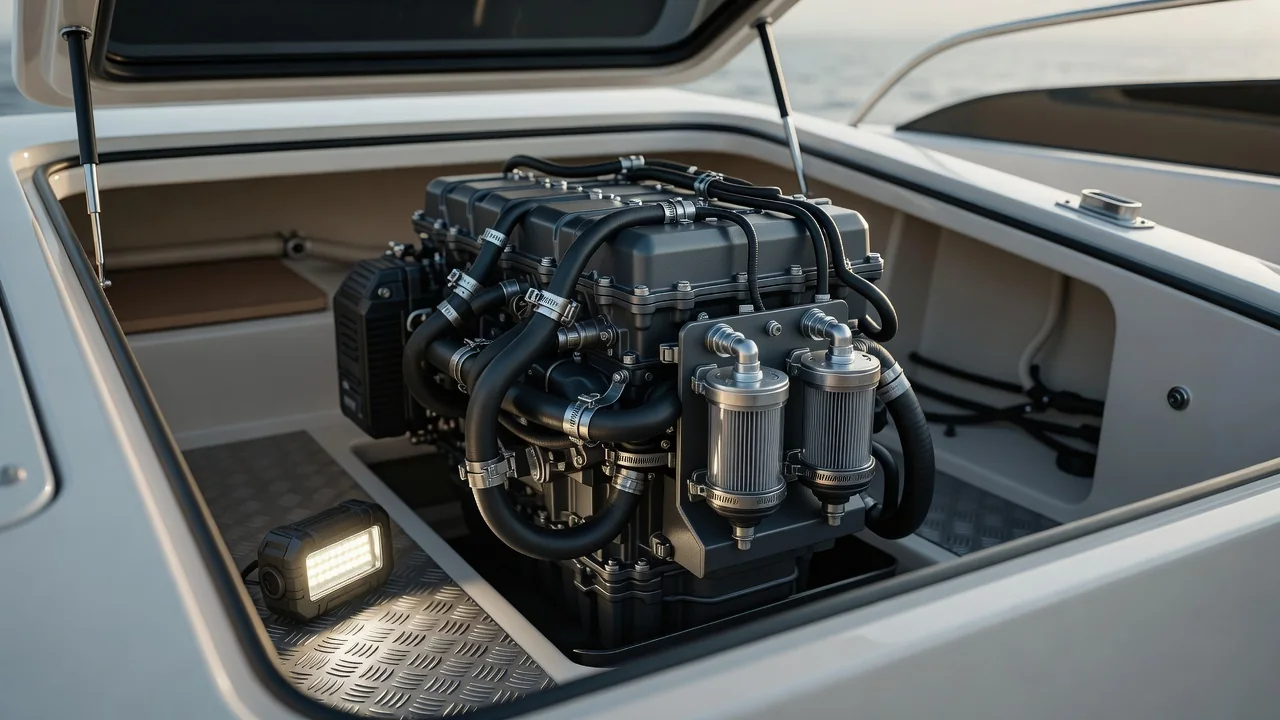
Fuel: The System That Deserves Paranoia
Dirty fuel causes the overwhelming majority of offshore diesel stoppages. Tank sludge that sits harmlessly at the bottom for years gets stirred into suspension the first time the boat pounds into a head sea for 24 hours straight. The defence has three layers. First, a primary filter with a clear bowl, checked daily for water and the black slime of microbial growth. Second, a dual-filter setup or a vacuum gauge on the primary so a clogging element shows itself before the engine starves; a reading creeping above 7 inches of mercury means change the element at the next calm watch, not next week. Third, a crew that can bleed the fuel system in the dark, because the one time you forget the procedure is the one time the engine dies at the harbour mouth.
Every crew member should know the bleed sequence for the specific engine aboard: which screw on the secondary filter housing, which lever on the lift pump, and how long to crank before giving the starter a rest. A laminated card beside the engine panel with the five steps in order has saved more passages than any single spare part.
- Two spare primary elements and two secondary filters for every 1,000 miles.
- Three raw-water impellers, because they fail in threes and the gasket tears on removal.
- A spare alternator belt, engine zincs and a full gasket set for the raw-water pump.
- Biocide treatment added to every fuel fill before a long passage.
| Interval | Task | Why It Matters Offshore |
|---|---|---|
| Daily | Oil, coolant, bilge sniff, filter bowl glance | Catches weeps and water before damage |
| Every 100 hours | Oil and filter change | Extended low-rpm motoring dilutes oil with fuel |
| Every 200 hours | Check impeller, belts, hose clamps | Impeller vanes fatigue without warning |
| Before departure | Full fuel polish or fresh filters, spare parts audit | Sludge wakes up in the first seaway |
Overheating: The Fast Failure
An overheating alarm at sea almost always means the raw-water side: a plastic bag over the intake, a thrown impeller, or a clogged heat exchanger. The drill is to throttle back immediately, check the exhaust for water flow, then work the chain from seacock to exhaust elbow. Skippers who run the engine hard to charge batteries at 1,400 rpm for hours should know that many small diesels glaze their bores and coke the elbow at prolonged light load; 20 minutes at 75 percent load every few hours of charging keeps the engine honest. When in doubt, sail. The engine is a tool, not a religion, and the boat that cannot sail without it is not ready to leave.
None of this requires a mechanic's ticket. It requires the humility to do the boring checks daily and the discipline to fix small things at anchor instead of hoping they hold. The ocean respects engines the same way it respects crews: the ones that arrive are the ones that were looked after on the quiet days.