
The Offshore Sail Inventory: What to Carry and How to Repair It at Sea
A mainsail that rips along the leech 600 miles from the nearest loft is not an inconvenience; it is a schedule-ending event. Offshore sailors learned long ago that a sail inventory is not about speed but about redundancy. The boat that crosses an ocean comfortably usually carries fewer racing laminates and more honest Dacron, plus the needles, twine and sticky-back Dacron to fix what the sea breaks. This guide walks through the sails worth the locker space and the repairs a two-person crew can realistically manage between watches.
The Working Set That Earns Its Keep
Most production cruising boats leave the dock with a full-batten mainsail and a 135 percent genoa. That combination works fine for weekend coastal hops, but offshore it leaves a gap between 20 and 30 knots apparent where the genoa is too big and the bare main is too small. The fix is a working jib of roughly 90 to 100 percent on an inner stay or a furler, and a main with at least two deep reef points, each reducing sail area by about 25 percent. A well-cut third reef or a separate trysail covers the top end of the scale.
Downwind, the choice splits the fleet. A cruising asymmetric spinnaker in a sock is simple and forgiving, but it collapses in sloppy seas and loads the bow roller. Twin headsails poled out on either side are slower to set up yet steer themselves for days with almost no chafe. For boats without a spinnaker, a preventer on the main and a poled-out genoa cover 80 percent of trade-wind miles at a fraction of the drama.
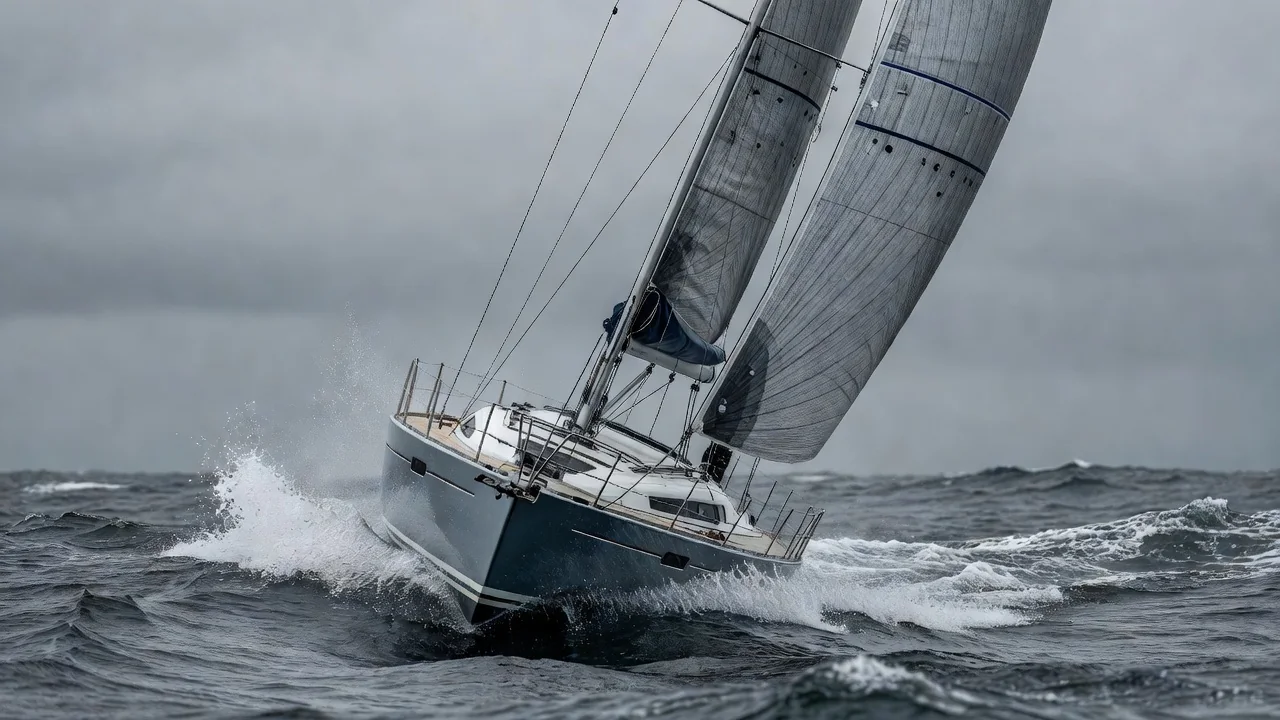
Storm Sails: Buy Once, Rig Before You Need Them
A storm jib of 5 to 8 percent of the foretriangle and a trysail of about 25 percent of the main area are the insurance policies of the sail plan. The mistake most crews make is leaving them bagged until the barometer has already fallen 10 millibars. Rigging a trysail track and running the sheets in flat water takes 20 minutes; doing it at 3 a.m. in 40 knots takes an hour and a crew member's nerves. Practice the full setup in a fresh breeze before the passage, and write the halyard routing on a card taped inside the companionway.
- Working jib and two-reef main as the default upwind combination.
- Storm jib and trysail rigged and tested before departure.
- One downwind solution the crew can deploy in under ten minutes.
- Spare halyard run and marked so a blown halyard is a swap, not a trip up the mast.
The Repair Kit and What It Can Actually Fix
A realistic offshore sail-repair kit fits in a small duffel: a palm and needles, waxed polyester twine in two weights, a roll of 30-centimetre sticky-back Dacron, webbing, grommets, a hot knife and a tube of polyurethane adhesive such as 3M 5200 for load-path patches. With those items a crew can restitch a 2-metre seam failure in about three hours of cockpit work, patch a spreader puncture, and rebuild a headboard webbing loop. What the kit cannot fix is a torn laminate sail whose film has creased, or a mainsail luff that has peeled off the mast track cars; those are jury-rig jobs that mean sailing deep reefed to the nearest port.
| Damage | At-Sea Fix | Time Needed | Sailing Afterward |
|---|---|---|---|
| Seam split under 2 m | Hand-stitch with palm, patch both sides | 2–4 hours | Full use, one reef caution |
| Spreader puncture | Sticky-back Dacron both faces | 1 hour | Full use downwind |
| Broken battens | Splint with spare batten stock | 1–2 hours | Reduced hoist |
| Torn headboard | Webbing strop and grommets | 3–5 hours | Reefed sailing only |
Chafe: The Slow Killer Nobody Notices
More ocean crossings are slowed by chafe than by dramatic tears. A genoa sheet that rides over a lifeline for 2,000 miles will part on the last windy night of the passage, because polyester loses up to half its strength once the cover is worn through. The defence is boring and effective: leather or hose chafe guards at every spreader tip, sheet leads adjusted daily so the wear point moves, and a daily walk-around with a headlamp looking for the white fuzz that signals a cover giving up. Ten minutes of inspection per day is the cheapest sail loft in the world.
Sail care offshore is mostly salt management and flaking discipline. Rinse nothing, because fresh water is too precious, but flake the main so the batten pockets do not take a permanent set, and furl the genoa with an even roll so the UV cover actually protects the leech. The crews who arrive with sails intact are rarely the ones with the newest cloth. They are the ones who treated every hour at anchor as maintenance time and every strange noise from aloft as a reason to slow down and look.