
The Offshore Energy Budget: Batteries, Charging and What to Turn Off
Every offshore boat is a small power utility with a demand problem. The autopilot draws 3 to 5 amps around the clock, the chartplotter another 2, the fridge cycles at 4, and suddenly a modest cruising yacht needs 150 to 250 amp-hours a day before anyone turns on a cabin light. Crews who leave the dock without an honest energy budget discover the deficit on day four, when the batteries sag and the engine hours start climbing. A working budget is simple arithmetic: list every consumer, count the hours, and match the total against what solar, wind and the alternator can actually deliver at sea, not at the dock.
Counting the Loads Honestly
The trap in energy budgeting is nameplate optimism. A fridge rated at 4 amps runs half the day in the tropics, not a third; an autopilot steering a loaded boat downwind in a quartering sea works twice as hard as the brochure assumes. The fix is to measure, not guess: a battery monitor like a shunt-based meter tells the truth after a week at anchor. A realistic 24-hour budget for a 40-footer with a crew of four usually lands near 200 amp-hours at 12 volts, with the autopilot and refrigeration accounting for two-thirds of it. That number is the boss of the passage; every charging decision serves it.
Charging Sources Ranked by Honesty
Solar is the silent hero of the trade-wind passage. Four hundred watts of rigid panels on a stern arch, angled within reach of the sun for six hours, will return 120 to 160 amp-hours on a clear day in the tropics and half that under cloud. Wind generators earn their keep on blustery reaches and at anchor, but on a downwind passage the apparent wind drops to nothing and so does the output. The engine alternator is the reliable brute: an hour of motoring at 1,800 rpm through a 100-amp alternator with a smart regulator replaces 60 to 80 amp-hours, which is why many crews simply schedule one charging hour at dawn and one at dusk and stop thinking about it. Hydrogenerators trail behind and make power from boat speed itself, delivering 5 to 15 amps continuously above six knots, but they cost speed and money and earn their place mainly on faster boats.
- Lead the budget with measured consumption from a shunt monitor, not brochure figures.
- Size solar to cover at least 60 percent of daily draw in expected conditions.
- Keep the alternator and regulator healthy; it is the guaranteed top-up when the sky refuses.
- Log state of charge at every watch change so a deficit is a trend, not a surprise.
| Source | Realistic Daily Yield | Conditions Needed | Weakness |
|---|---|---|---|
| 400 W solar | 100–160 Ah | Six hours of clear sun | Cloud, shading from sails |
| Wind generator | 20–100 Ah | 12+ knots apparent wind | Silent on downwind runs |
| Engine alternator | 60–80 Ah per hour | Fuel and a working engine | Noise, engine wear, fuel |
| Hydrogenerator | 120–300 Ah | Six knots of boat speed | Drag, cost, weeds |
What to Turn Off When Things Get Tight
Every passage needs a load-shedding ladder agreed before departure. First rung: cabin fans, courtesy lights, the second fridge compressor. Second: the chartplotter at night replaced by a tablet on a 12-volt socket, instruments dimmed, radar off and used only for squall checks. Third, the hard rung: hand-steering in shifts to kill the autopilot, fridge turned into an icebox. The ladder works because everyone knows it in advance; nothing corrodes crew relations like discovering at midnight that one person ran the watermaker while the batteries were at 60 percent.
Batteries: The Tank Under the Floor
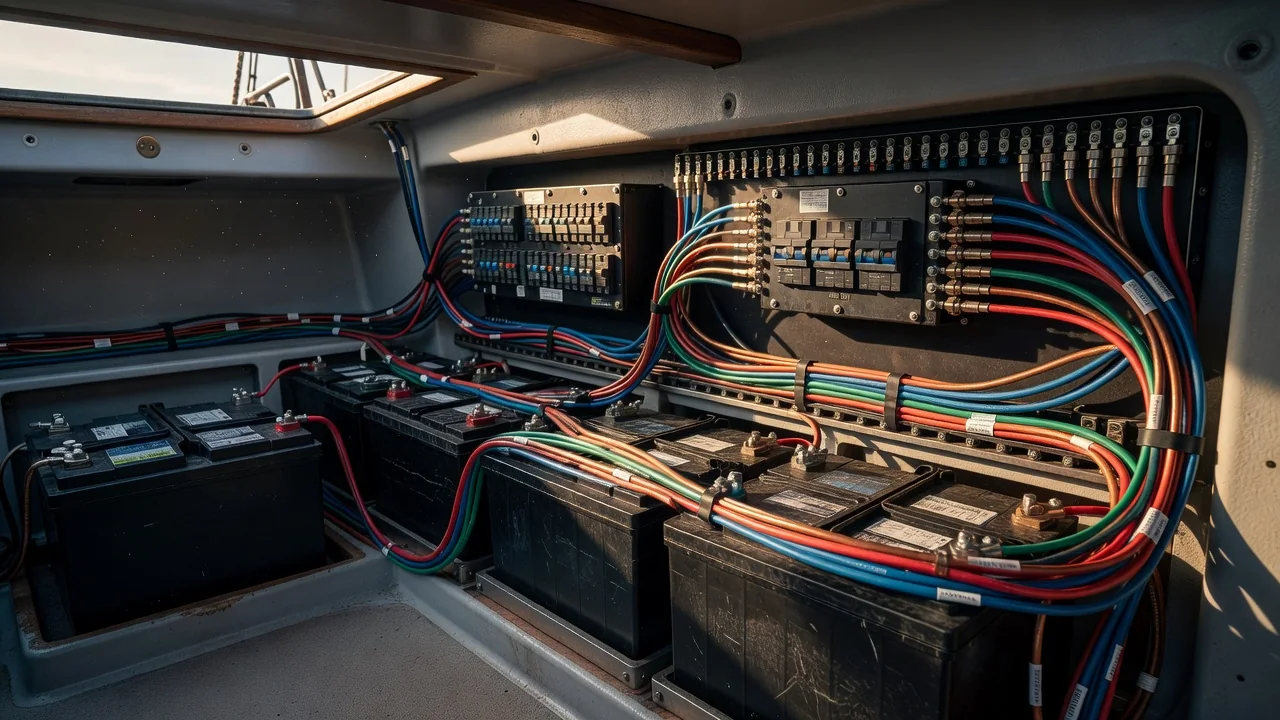
The bank itself deserves respect. Four hundred amp-hours of AGM or lithium gives a crew of four about two days of autonomy without charging, which covers a cloudy calm spell. Lithium iron phosphate banks accept charge fast, weigh half as much and tolerate deep discharge, but they demand a proper management system and cost two to three times more upfront. Whatever the chemistry, the rules offshore are the same: never let voltage sit below 12.0 volts under load, keep terminals clean of the green fuzz that creeps in salt air, and know which switch isolates the bank if a cable chafes through at 2 a.m.
An energy budget is not a spreadsheet exercise; it is the difference between a boat that arrives with cold drinks and working instruments and one that motors into harbour with a dead autopilot and a warm fridge. Count the amps, respect the weather's share of the answer, and the lights stay on all the way across.