
Watermakers and Water Management: How Much You Really Need Offshore
Water is the one consumable that cannot be rationed past a point and cannot be borrowed at sea. A crew of four on a 21-day passage will drink, cook and wash their way through 400 to 600 litres, and the moment the tanks run low every other decision on board gets worse. The choice is simple to state and hard to execute: carry enough, make it underway, or do both with a safety margin that assumes the worst week, not the average one. This is how experienced crews do the maths and keep the water flowing when the passage runs long.
The Real Numbers Per Person
The planning figure most offshore skippers use is 3 litres per person per day for drinking and cooking in temperate conditions, rising to 4 to 5 litres in the tropics where sweat loss doubles. Add a litre a day for washing up with salt water and a solar-shower rinse every third day, and a crew of four needs roughly 15 litres daily, or 320 litres for three weeks with no reserve. The reserve is the part people skip: a dead watermaker, a contaminated tank or a dismasting diversion can add a week, so prudent skippers plan 50 percent on top. That puts the real target near 480 litres, split across at least two tanks so one leak does not empty the ship.
Tanks, Jerrycans and the Case for Both
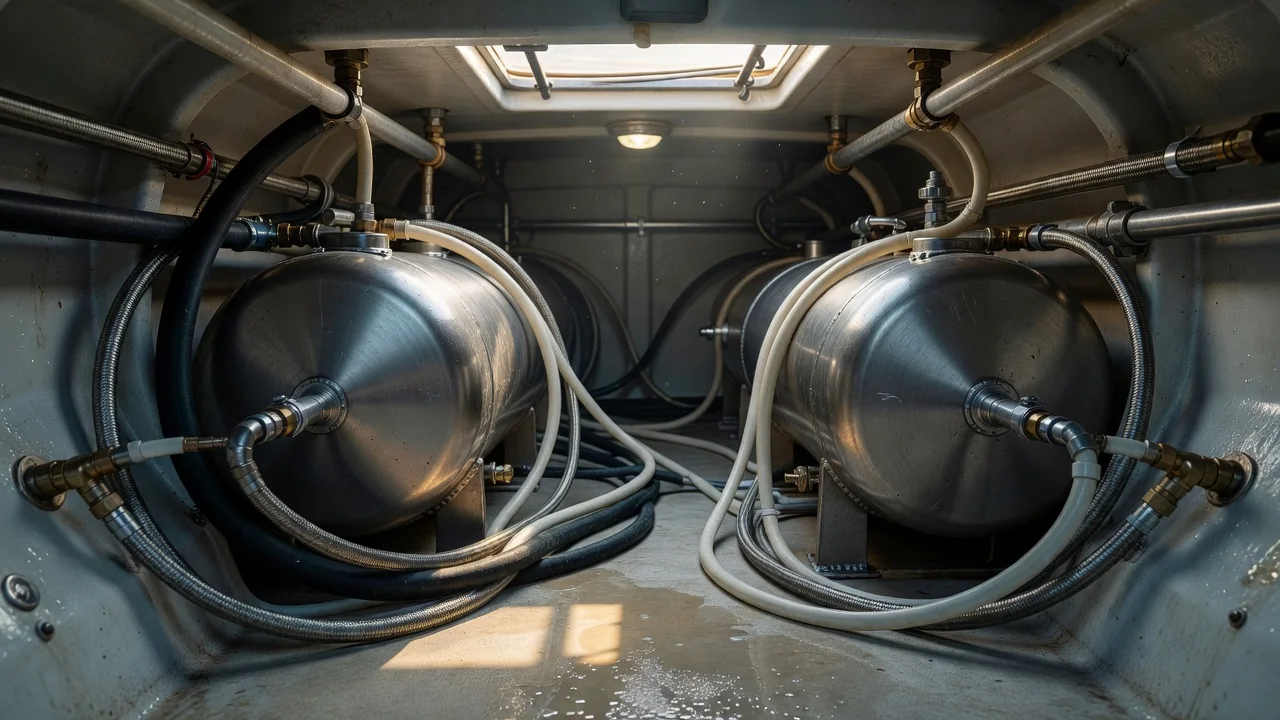
Tank water and jerrycan water serve different masters. Tanks are convenient but vulnerable: a single cracked fitting can drain 200 litres into the bilge overnight, and tank water pumped through old hoses picks up a plastic taste that quietly reduces how much the crew drinks. Jerrycans are the gold reserve. Twenty-litre containers lashed on deck or in a locker are immune to plumbing failures, easy to rotate, and provide an honest gauge of consumption; when the last marked jerrycan opens, everyone on board knows exactly where the passage stands. Many ocean veterans keep 80 to 100 litres in jerrycans untouched as an abandon-ship and emergency supply that never enters the daily budget.
- Two independent tanks with separate pumps or a crossover valve.
- Eighty litres minimum in jerrycans, never counted in the daily plan.
- A manual backup pump or a way to draw water if the electrics die.
- Tank vents screened and deck fills labelled so salt water never enters by mistake.
Watermakers: Marvelous, Fragile, Worth It
A 12-volt watermaker producing 20 to 30 litres per hour changes the psychology of a passage: showers return, laundry happens, and the tank gauge stops being a source of quiet dread. The catch is reliability. Membranes foul if run in silty anchorages, high-pressure pumps need their seals, and the unit demands 15 to 20 amps that must come from solar or the engine. The crews who swear by their watermakers are the ones who run them every two or three days in clean ocean water, pickle them properly when idle, and carry the rebuild kit. The crews who curse them treated the unit like a household appliance. A watermaker is a crew member: feed it clean water and power and it works; neglect it and it quits in the middle of the doldrums.
| Source | Typical Daily Yield | Failure Mode | Backup |
|---|---|---|---|
| Main tank 200 L | As pumped, 13–15 L | Cracked fitting drains all | Second tank, crossover closed |
| Watermaker 12 V | 40–60 L in 2 h run | Fouled membrane, dead pump | Rebuild kit, strict tank habit |
| Jerrycans 80 L | Emergency only | Almost none | Itself the backup |
| Rain catching | 0–30 L, weather-dependent | No rain in the trades | Bonus only, never planned |
Hygiene Without Waste
Salt water does more than crews expect. Dishes washed in salt water and rinsed in a cup of fresh come out clean enough for health; bodies lathered with special salt-water soap on deck and rinsed with two litres feel human again. The disciplines that stretch a tank are small: a spray head on the galley tap, foot pumps instead of pressure water, and a hard rule that nobody brushes teeth with a running tap. One bad habit, like a pressure-water toilet left on, can cost 10 litres a day without anyone noticing.
The crews that never worry about water share one habit: they know their number. The log shows litres per day, the jerrycans show the reserve, and the watermaker, if fitted, is exercised like a muscle rather than worshipped like a talisman. Plan for the bad week, and the good weeks take care of themselves.