
Offshore Communications in 2026: Satellite, SSB, AIS and What Actually Works
By 2026, offshore sailors have more communication choices than ever, yet the ocean still has a way of exposing weak spots. Satellite messengers like Garmin inReach and ZOLEO dominate for position tracking and short texts, while Iridium GO! and Starlink Mini handle heavier data loads. SSB radio refuses to die on long passages, and AIS remains the unsung hero of collision avoidance. The trick isn’t picking the shiniest gadget; it’s building layers that overlap so one dead battery or blocked signal doesn’t leave you mute.
Most cruisers now carry at least three independent systems. A modern setup might include an EPIRB registered to the boat, a personal locator beacon on the skipper’s lifejacket, an AIS transceiver with active collision alarms, a satellite messenger for family check-ins, and either SSB or a satphone for longer conversations. The combination feels almost luxurious compared with the single-sideband-only world of twenty years ago, yet every piece still has limitations that matter when the weather turns ugly.
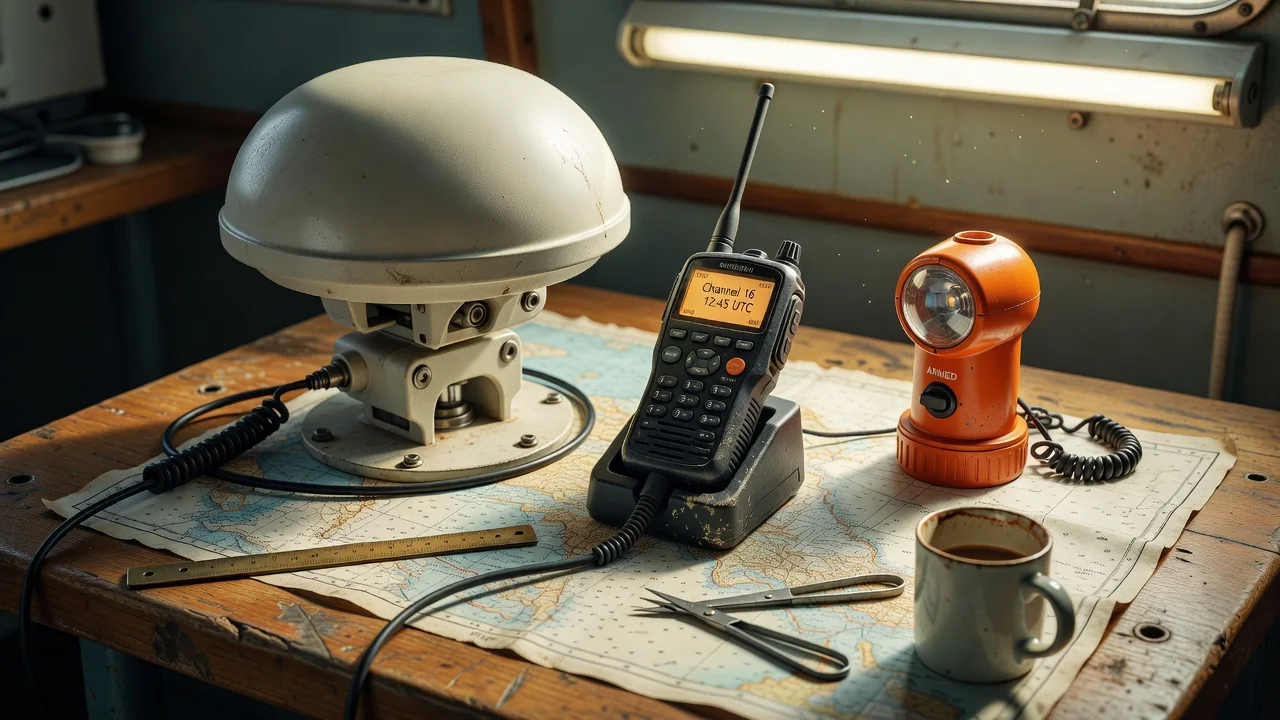
Satellite Options: Speed, Cost, and Coverage
Iridium’s low-earth orbit constellation still rules for true global coverage, including both poles. In 2026 a monthly Iridium GO! plan with 150 minutes of voice and modest data runs about $165. Starlink Mini, now marinized with better weatherproofing, delivers broadband speeds but needs a clear view of the sky and draws more power. Many crews use Starlink for weather routing and Netflix during calm trades, then fall back to Iridium when seas kick up and the dish loses lock. Garmin inReach Mini 2 remains the cheapest always-on tracker at roughly $450 upfront plus $65 monthly for unlimited SOS and 50 messages.
SSB, Cruiser Nets, and Weather Fax
Despite satellite hype, single-sideband radio is still the social glue of the offshore world. The 8 a.m. Pacific Puddle Jump net and the Caribbean Cruiser Net on 4.025 MHz remain active in 2026. Experienced sailors listen daily not just for weather but for mechanical advice, medical help, and the reassurance of other voices. A well-installed Icom M802 with a proper backstay antenna and tuner costs under $2,000 installed and uses almost no power compared with satellite terminals. The catch: you need propagation and someone on the other end. When solar storms hit, the bands go quiet and you suddenly appreciate that inReach sitting in its cradle.
VHF and Class B+ AIS have become non-negotiable. Modern transceivers integrate with chartplotters to draw target vectors and sound alarms when a ship closes inside three miles. During the 2025 Atlantic crossing season, several yachts credited their active AIS with forcing tankers to alter course in thick fog. Pair that with a good radar and you have two independent eyes on traffic even when satellite screens go dark.
Building a Realistic Comms Budget and Layered Plan
Here’s what a typical 2026 bluewater season actually costs for a couple sailing from the Canaries to the Caribbean and up the East Coast:
| Item | Upfront Cost | Annual Recurring |
|---|---|---|
| Iridium GO! + 150-min plan | $1,250 | $1,980 |
| Garmin inReach Mini 2 | $450 | $780 |
| Icom SSB installation | $2,100 | $120 (antenna tune-ups) |
| EPIRB + two PLBs | $1,180 | $0 (10-year battery) |
| Starlink Mini (optional) | $599 | $1,200 |
Total first-year outlay often lands between $5,500 and $8,000 depending on how much redundancy you want. After that, expect $2,800–$4,200 per year. Those numbers feel painful until you compare them with the cost of losing the boat because you couldn’t call for help or reroute around a hurricane.
- Carry one device that works without line-of-sight (SSB or Iridium)
- Carry one device that works with line-of-sight (Starlink, VHF, or handheld sat messenger)
- Carry one device that works when you’re in the water (EPIRB/PLB with integrated AIS)
- Test every system before you leave the dock and again after the first heavy rain
- Write a one-page comms plan that lists frequencies, contact numbers, and daily check-in times; laminate it and post it above the nav station
The best offshore communications setup in 2026 isn’t the most expensive. It’s the one you actually understand, the one whose batteries you keep charged, and the one that still gives you options when the first two layers fail. Sailors who treat comms as a layered insurance policy rather than a single magic box sleep better on passage. The ocean hasn’t changed. Only our ability to talk back to it has.