
Celestial Navigation as Backup: How Much Do You Really Need in 2026
Every offshore boat in 2026 navigates by satellite, and every honest offshore sailor knows that the system they trust is one lightning strike away from silence. A flooded chart table, a dead battery bank, a GPS antenna taken out by a loose halyard: the failure modes are ordinary, and mid-ocean they leave a crew with a sextant in the locker or with nothing at all. The question for the modern cruiser is not whether celestial navigation is romantic; it is how much of it is worth learning and carrying as a backup, and what a minimal, realistic capability looks like for a crew that will probably never need it.
The Failure Scenario Worth Planning For
Total electronic failure offshore is rare but documented: lightning is the classic cause, taking out every circuit with an antenna in a single strike, and salt water finds the rest. A boat 1,000 miles from land with no position faces a simple problem with an ancient solution. The sun at noon, measured with a sextant, yields latitude within a couple of miles using nothing more than an almanac and a watch. Longitude is harder, demanding precise time and more sight reduction, but a noon latitude plus a compass course is enough to steer for a coastline and make a safe landfall along it. That modest capability, not ocean-racer precision, is the realistic backup goal.
The Minimal Kit and What It Costs
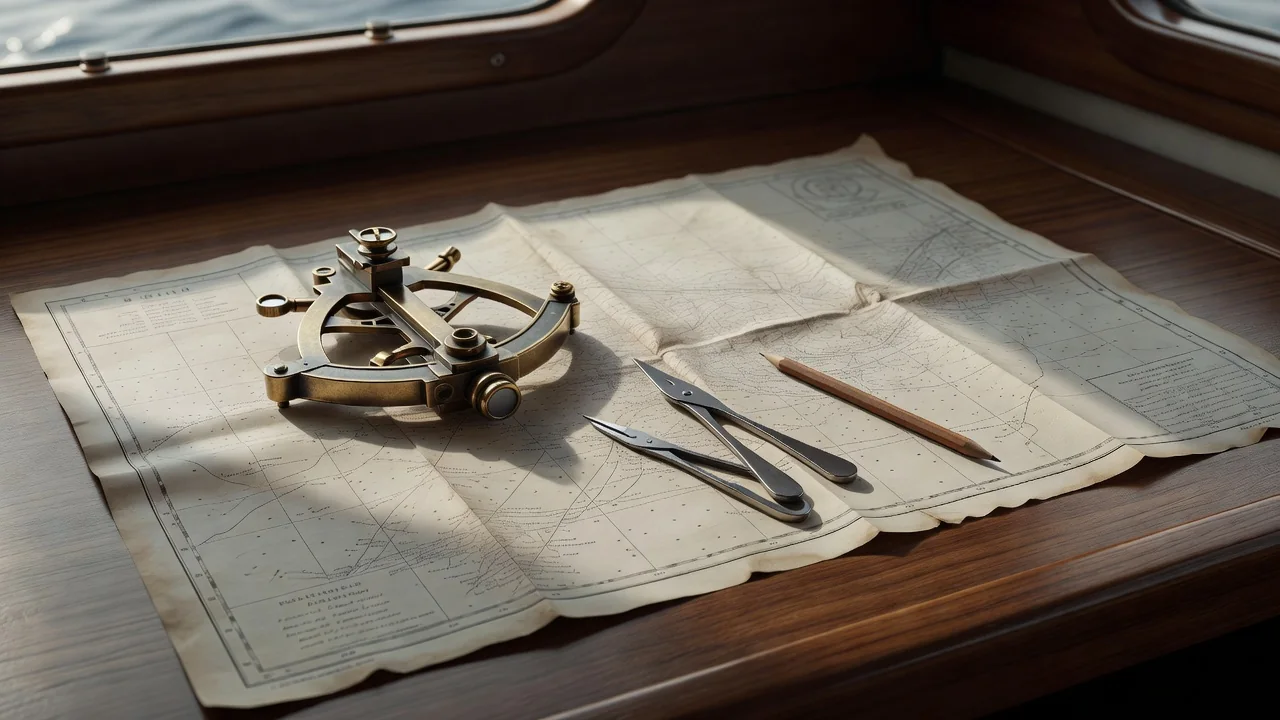
A functional celestial backup fits in a small locker. The sextant itself need not be a museum piece; a reliable metal instrument costs a few hundred euros and plastic practice models far less, though the plastic arcs flex in heat and teach bad habits. The current Nautical Almanac carries the positions of sun, moon, planets and stars for the year, and sight-reduction tables or a simple set of precomputed forms turn the raw angles into a position line. Add a quartz watch checked against radio time signals before departure, a plotting sheet, pencils and dividers, and the whole kit weighs less than a litre of water. The total investment is roughly the price of a single chartplotter, and unlike the plotter it is immune to everything except clouds.
- Metal sextant with a good horizon mirror, stored padded and dry.
- Current-year Nautical Almanac; the data expires, the instrument does not.
- Sight-reduction tables or precomputed sun forms matched to expected latitudes.
- Quartz watch rated against a time signal, with its error logged before departure.
The Learning Curve, Honestly Described
The barrier is not mathematics; the noon-sun sight involves adding and subtracting angles, nothing more. The barrier is the handling skill: bringing the sun's image down to a horizon that rises and falls on a three-metre swell, rocking the arc to find the true vertical, and reading the drum while braced in a hatch. Competence takes practice, and the only honest way to get it is at sea or on the water regularly. Ten noon sights taken on coastal sails, reduced the same day, build more skill than any course ashore. Crews who learn together gain a second benefit: a shared ritual at midday that structures the day and keeps the log honest.
| Capability | Skill Required | Accuracy | Time to Learn |
|---|---|---|---|
| Noon-sun latitude | Basic sight, one formula | 1–3 miles | A weekend plus practice |
| Sun sight lines | Intercept method, tables | 3–10 miles | A month of practice |
| Star sights | Twilight timing, star ID | 2–5 miles | A season of twilights |
| Full celestial fix | All of the above combined | 2–5 miles | Ongoing craft |
Backup Upon Backup
Celestial navigation sits at the end of a redundancy chain that should be built first: a second independent chartplotter or tablet with offline charts, a handheld GPS with spare batteries stored in a Faraday bag or metal box against lightning, paper charts of the passage area and the approaches, and a magnetic compass that has been swung and whose deviation card is current. The sextant is the layer that survives when even the handheld unit fails, and its true value is psychological as much as navigational. A crew that knows it can always find its latitude sails with a calm that no amount of electronics quite provides.
Nobody needs to navigate an ocean by the stars in 2026. But the sailor who can take a noon sight owns a skill three thousand years old, and on the one bad day when the screens go dark, that skill is the difference between a boat that is lost and a boat that is merely inconvenienced.