
Night Sailing and Landfall: Approaching an Unknown Coast After Dark
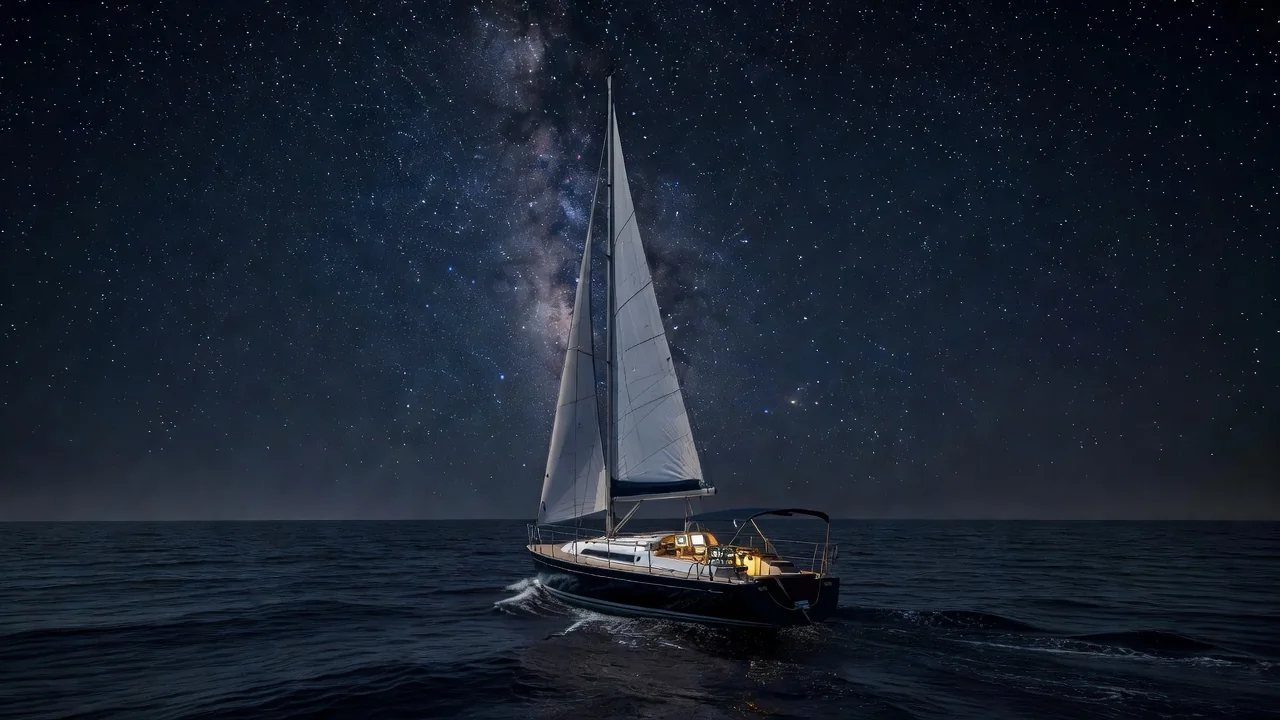
Every landfall begins long before the land. The final 50 miles of an ocean passage are statistically the most dangerous: the crew is tired, the coast is unfamiliar, shipping concentrates near ports, and the temptation to arrive tonight instead of tomorrow morning has put more yachts on reefs than any storm. Night sailing offshore is a skill of its own, and the approach to an unknown coast in darkness is its final exam. The skippers who do it well share a set of habits that sound conservative and are simply professional: slow down, stand off, and never let a schedule outrank a reef.
Seeing and Being Seen After Dark
Night vision is a resource that takes 30 minutes to build and one careless white light to destroy. The discipline starts at the nav station: red lighting below, instruments dimmed to the lowest readable setting, and torches banned on deck in favour of red headlamps. Out on watch, the rules invert the daytime instinct. Look slightly away from a faint contact to catch it with the eye's more sensitive periphery, and trust that most ships appear first as a loom on the horizon before their sidelights resolve. Being seen matters just as much: navigation lights checked before departure, a tricolour at the masthead that is visible further than a pulpit lamp, and a radar reflector hoisted where it actually returns an echo, because a fibreglass hull is nearly invisible to a ship's radar at five miles.
The Night Watch Routine
A good night watch is boring by design. The watchkeeper scans the full horizon every ten to fifteen minutes, checks the AIS and radar if fitted, logs position hourly, and calls the skipper on the triggers agreed before dark: any contact closing inside three miles, wind up five knots sustained, any light that cannot be identified. Sail plans shrink at night for a reason: a reef taken at sunset costs two knots and buys a calm response to the squall that arrives at 2 a.m. without announcing itself on any forecast. The kettle matters too. A crew fed and warm at 3 a.m. makes better decisions than a heroic one shivering on instant coffee.
- Reef before dark; unshaking a reef at noon is free, at 3 a.m. it is a crisis.
- Horizon scan every ten to fifteen minutes, logged, so the duty is a habit not an intention.
- Agree skipper-call triggers at sunset and honour them without embarrassment.
- Clip on at night without exception, even in the cockpit, even in a calm.
Landfall: The Exam at the End of the Passage
The approach to an unknown coast after an ocean crossing follows a logic older than chartplotters. Confirm the position by every means available, GPS, depth contour, and the expected sequence of lights, and distrust any single source. Soundings are the ancient cross-check: the hundred-metre line appears where the chart says it should, and a depth that disagrees with the plotter is a reason to stop and think, not to argue with the echo sounder. Currents near land run stronger and shiftier than anything offshore, and a lee shore in the dark forgives nothing. The professional habit is the offshore waiting position: if the arithmetic says arrival at midnight, the skipper slows down fifty miles out, heaves to or sails a holding pattern outside the dangers, and comes in with the dawn. The harbour has waited centuries; it will wait until morning.
| Situation | Amateur Instinct | Professional Move |
|---|---|---|
| Arrival computed for midnight | Push on, enter by plotter | Stand off, enter at first light |
| Depth disagrees with GPS | Trust the satellite | Stop, re-verify position by all sources |
| Unknown light on the bow | Assume it matches the chart | Alter to seaward until identified |
| Squall line on the horizon at dusk | Keep sail up for speed | Reef early, tidy deck, brief the crew |
The Discipline of the Last Night
Skippers with many landfalls behind them describe the same arc: the ocean teaches its lessons over weeks, then examines them in a single night. The passage is won offshore, in the maintenance and the watch routine and the weather choices, but it is lost, when it is lost, within sight of land. Slow down, stand off, wait for the sun. The dawn landfall, with the coast laid out in grey and gold and every mark matching the chart, is not the cautious option. It is the reward.