
Liferaft and Ditch Bag: Preparing for the Passage You Hope Never to Make
Nobody buys a liferaft expecting to use it. The purchase is an act of professional pessimism: an admission that fire, collision or flooding can take the boat in minutes, and that the crew's survival then depends on a canister in the locker and a bag by the companionway. Offshore skippers who have stepped into a raft, and a few have, repeat the same lesson: the raft itself is only half the system. The other half is the ditch bag, the grab routine and the decisions rehearsed long before the order to abandon ship is ever given.
Choosing and Servicing the Raft
For ocean passages the choice narrows quickly: a raft rated for offshore or ocean service, packed in a canister rather than a valise, with an insulated double floor, a ballast system to resist capsize and a canopy with boarding ramp. Capacity matters more than buyers expect; a four-person raft carries four people in genuine misery, so many crews of four buy the six-person model. The service interval is typically three years, and the service itself is where quality shows: a reputable station will open the raft, test the inflation, replace the emergency pack contents and return a dated certificate. A raft one year overdue on service is not a raft; it is a heavy orange gamble.
Mounting: The Detail That Decides Everything
A raft that cannot be launched in 30 seconds is cargo. The canister belongs on deck or in a dedicated locker that opens to the sky, secured with a hydrostatic release unit set to fire at roughly four metres of depth. The painter must be tied to a strong point before the passage begins, not rigged on the night it is needed. Crews should also rehearse the ugly scenario: if the boat goes down fast, the hydrostatic release frees the raft as the hull sinks, and the painter, if rigged correctly, triggers inflation at the surface. Every crew member should be able to state, without thinking, where the raft is, how the lashings release, and who throws it overboard.
The Ditch Bag: Fifteen Minutes of Packing, Days of Survival
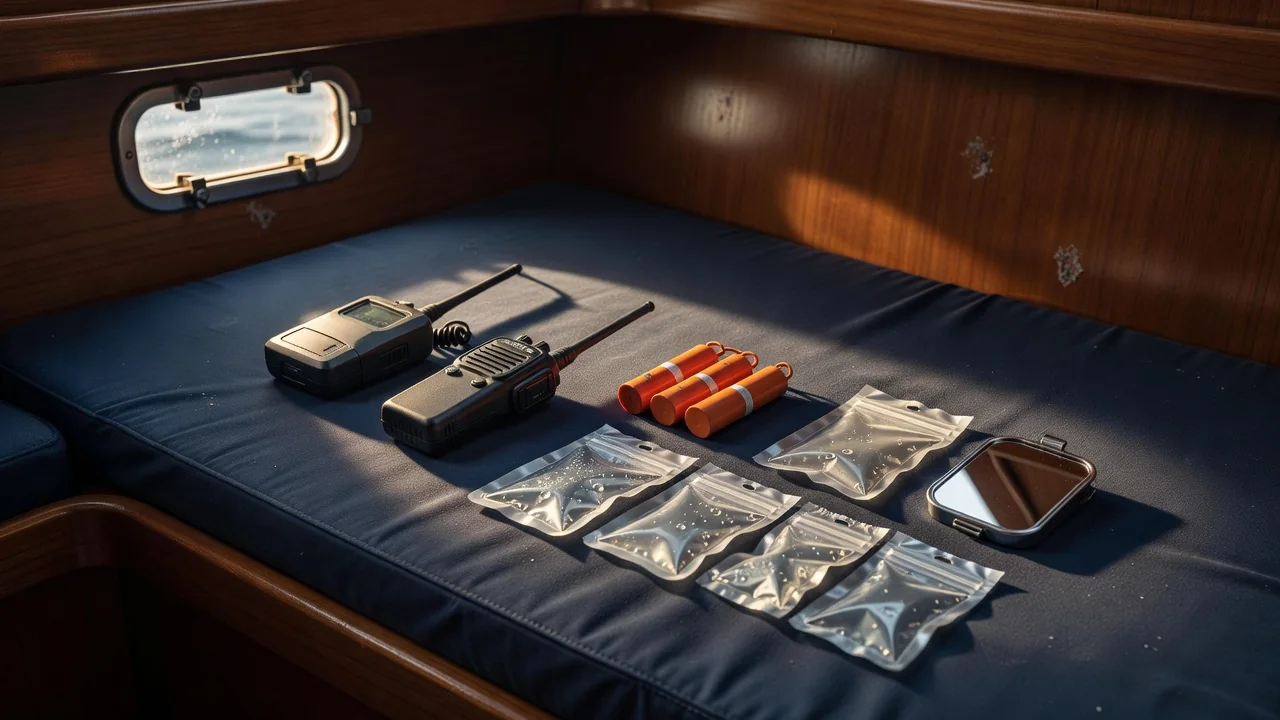
The ditch bag is the raft's brain. SOLAS raft packs assume rescue within 24 hours; an ocean crew must assume 72 hours or more, so the bag carries what the raft lacks. The core contents fit in a 30-litre floating grab bag: a registered EPIRB, a waterproof handheld VHF, a satellite communicator if the boat has one, a handheld GPS, a watermaker-free reserve of two litres of water per person in sealed pouches, high-calorie rations, flares, a first-aid pouch with seasickness tablets because a raft is the worst ride at sea, fishing kit, a multitool, a signal mirror and copies of passports and boat papers in a waterproof sleeve. Everything is tethered to the bag, and the bag is tethered to the raft, because equipment lost in the first chaotic minute never comes back.
- EPIRB mounted where it floats free, plus a second PLB worn or pocketed at night.
- Ditch bag stored at the companionway, never below the quarterberth pile.
- Water and rations rotated yearly; batteries and flares checked against expiry dates.
- A laminated abandon-ship card in the nav station listing who grabs what.
| Item | Where It Lives | Check Interval |
|---|---|---|
| Liferaft in canister | Deck cradle, hydrostatic release | Service every 3 years |
| EPIRB 406 MHz | Float-free bracket at companionway | Battery and self-test yearly |
| Ditch bag | Companionway, tethered | Full audit every 6 months |
| Handheld VHF and GPS | Inside ditch bag, charged | Charge monthly, batteries yearly |
The Decision Nobody Wants to Rehearse
The rule repeated by every survival instructor is step up into the raft: the boat is abandoned only when it is clearly sinking or burning beyond control, never in panic at a manageable crisis. Yet crews should still walk the sequence in daylight: who launches the raft, who carries the ditch bag, who accounts for every person, who cuts the painter last. Fifteen minutes of rehearsal per season costs nothing and converts a crew's worst hour into a procedure. The ocean forgives many things, but it does not forgive the crew that meets its emergency unpractised.