
The Offshore Medical Kit: What to Carry Beyond the First-Aid Box
Three hundred miles from the nearest clinic, the ship's medical kit stops being a box of plasters and becomes the only hospital within reach. The nearest helicopter may be a day away, and the nearest surgeon further still. Offshore crews do not need to become paramedics, but they do need a kit built for the injuries that actually happen at sea, the training to use it, and a plan for reaching professional help over a satellite connection. This is the layered approach that delivery skippers and ocean-crossing families rely on.
The Injuries the Ocean Actually Delivers
The offshore injury pattern is remarkably consistent. Deep cuts from galley knives and winch handles top the list, followed by burns from a stove gimbaling at the wrong moment, crush injuries to fingers caught between dock lines and cleats, sprains from falls below, and the infections that bloom in a warm, salty environment where wounds never quite dry out. Seasickness, toothaches and fishhooks round out the caseload. Notice what is missing: dramatic trauma is rare. The kit should be deep in wound closure materials, burn dressings, broad-spectrum antibiotics on prescription, and strong pain relief, not in heroic gear nobody knows how to use.
Building the Kit in Layers
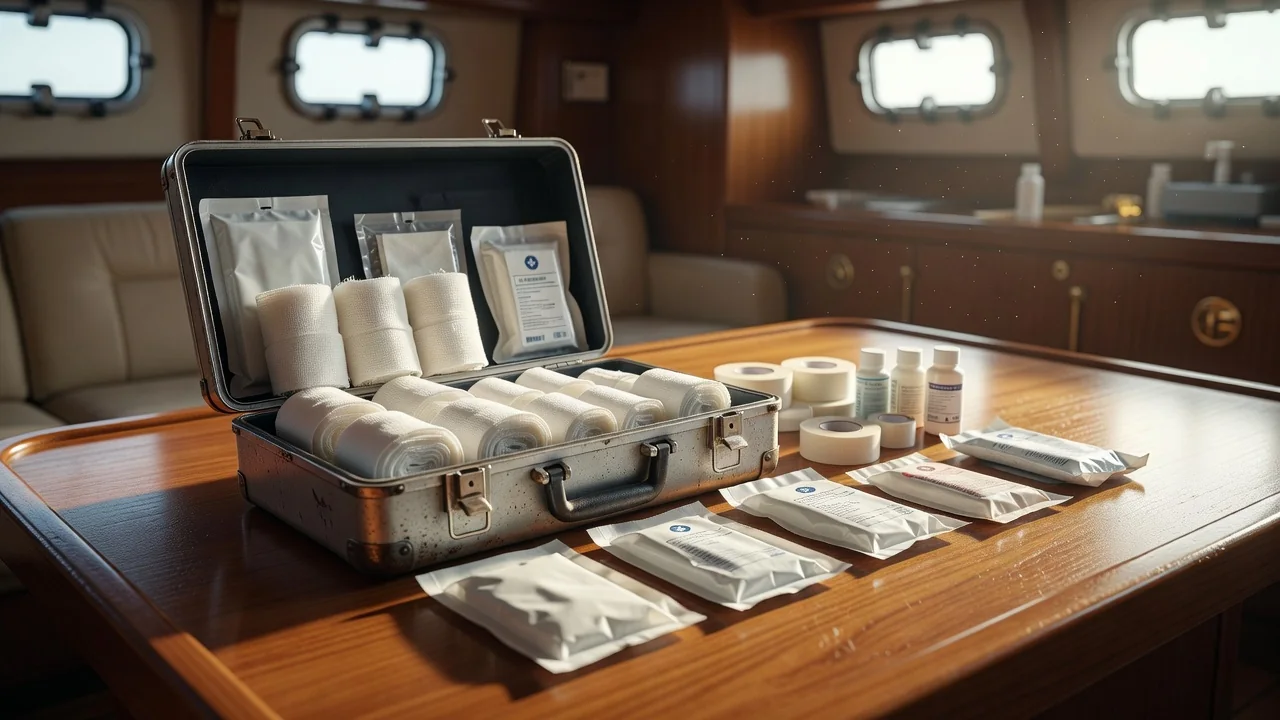
A practical offshore kit works in three tiers. The grab kit lives in the cockpit locker: gloves, trauma shears, a tourniquet, two pressure dressings and a space blanket, because the first minute of a serious bleed happens on deck, not at the chart table. The working kit is the daily box below: wound-closure strips, steri-strips, a suture or skin-staple kit for crews trained to use one, antiseptic, burn gel, splints and a thermometer. The pharmacy tier carries the prescription medicines arranged with a doctor before departure: two courses of a broad antibiotic such as amoxicillin-clavulanate, a second-line option for the penicillin-allergic, anti-nausea suppositories that work when oral tablets will not stay down, tramadol or equivalent for fracture-level pain, and a dental repair kit with temporary filling material.
- Inventory every item twice a year and replace anything within six months of expiry.
- Keep a written dosing card for each prescription drug, agreed with the prescribing doctor.
- Store the kit in a waterproof case that floats, marked so a stranger can find it in the dark.
- Log every treatment given; the telemedicine doctor will ask, and memory lies under stress.
Telemedicine: The Doctor in the Satellite
The single biggest change in offshore medicine is that expert advice now reaches mid-ocean. Services such as the free Maritime Telemedical Assistance network, run nationally by centres like CIRM in Rome and its international counterparts, connect sailors by satellite phone or email to physicians who manage cases at sea every week. A crew describing a spreading skin infection can send photos over a satellite messenger, receive a differential diagnosis, and get dosing instructions within hours. The catch is bandwidth and preparation: the consultation only works if the boat carries a working sat connection, the medical kit matches what the doctor expects to find, and the crew can take a pulse and a temperature accurately. Practise the phone call before you need it.
| Scenario | First Response | When to Call for Help |
|---|---|---|
| Deep cut, bleeding controlled | Clean, close with strips, dress | Signs of infection after 48 h |
| Burn larger than a palm | Cool 20 min, burn gel, loose dressing | Immediately, with photos |
| Suspected fracture | Splint, pain relief, log vitals | Immediately, discuss diversion |
| Seasickness over 48 h | Suppositories, sips of electrolytes | No urine output for 12 h |
The Human Factor
Gear without training is decoration. At least two people on board should hold a current first-aid certificate, and one should have completed a maritime medical course such as the MCA-recognised Proficiency in Medical Care or a wilderness first-responder equivalent. Run one scenario per passage: a simulated galley burn treated start to finish with the real kit. The exercise always finds the same gaps, a missing pair of gloves or a dead thermometer battery, and finding them in practice is the entire point.
Offshore medicine rewards the prepared and forgives the honest. A crew that knows its kit, treats aggressively early, and calls for advice before the situation becomes a crisis will handle almost everything the sea presents. The goal was never to be self-sufficient; it is to buy time, and time buys everything else.