
Man Overboard: Recovery Gear and Drills That Actually Work
A person overboard in mid-ocean is the emergency every sailing school teaches and almost no cruising crew has truly drilled. The statistics are unforgiving: most offshore man-overboard incidents end in recovery only when the casualty stayed clipped to the boat or was picked up within minutes by their own crew. There is no lifeboat service 800 miles from land. The entire strategy rests on three pillars: never leave the boat, mark and find anyone who does, and practice the recovery until it is boring. Here is what the gear and the drills look like when done properly.
Staying Attached: The Gear That Prevents the Emergency
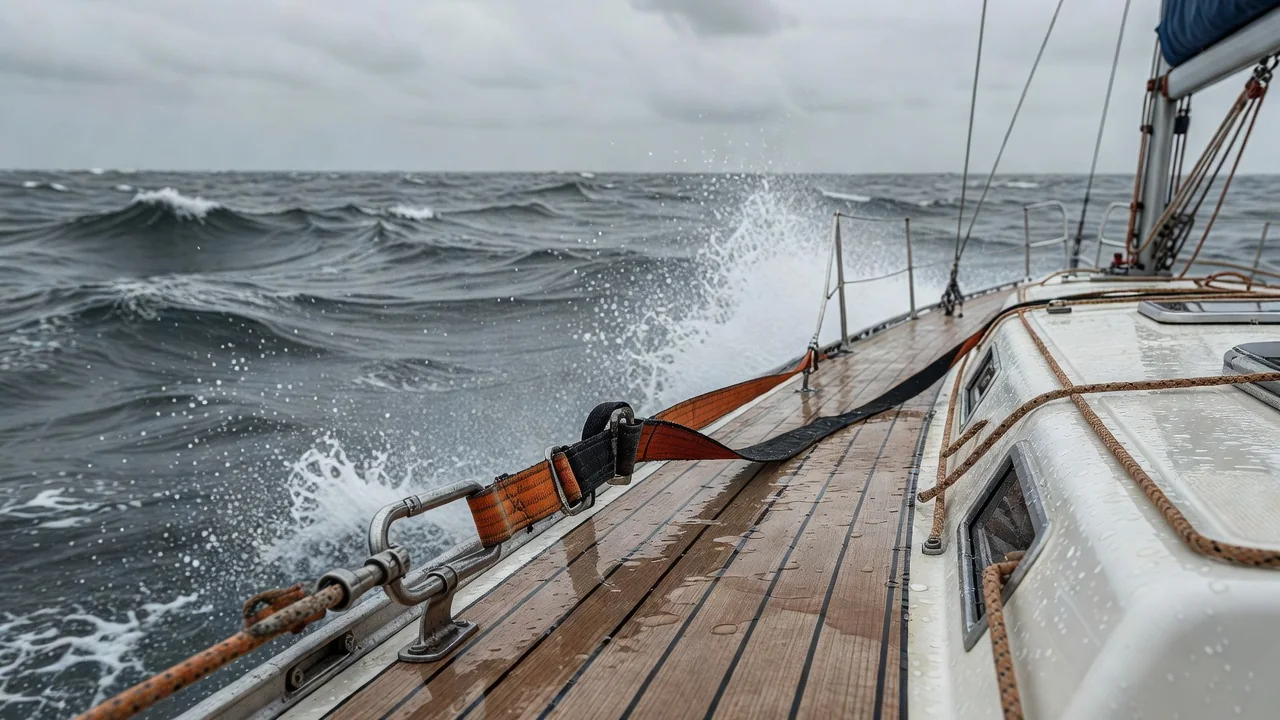
Every recovery article should start with prevention, because a sailor in the water at six knots of boat speed has minutes, not hours. The standard offshore setup is a three-point harness with an automatic crotch strap, paired with a two-leg tether: a short leg under a metre for working at the mast, a long leg for moving along the deck. Jacklines run from the bow to the cockpit on both sides, positioned inboard of the shrouds so a fallen crew member swings against the hull, not under the lifelines. The rules that make the gear work are cultural, not technical: clip on at night without exception, clip on when reefing, clip on whenever the wind exceeds 20 knots, and clip on when alone on deck while others sleep. Skippers who exempt themselves set the real rule.
Mark, Float, Find
If someone does go over, the first ten seconds decide everything. One person does nothing but point at the casualty and never looks away. A second hits the MOB button on the chartplotter and throws the danbuoy and horseshoe overboard together, because a floating marker is worthless if it drifts 200 metres from the swimmer. Personal locator beacons worn on the harness have changed this game: an AIS-MOB unit transmits the casualty's position to the boat's own plotter and any AIS-equipped vessel within miles, updating every few seconds. In daylight and calm water, crew-overboard modules can be recovered by eyesight alone; at night in a seaway, the AIS beacon is frequently the only thing standing between a drill and a funeral.
- AIS-MOB beacon on every harness, registered, tested and with a fresh battery each season.
- Danbuoy, horseshoe and light rigged together at the stern, ready to throw as one unit.
- MOB button within reach of both helm stations, tested before every passage.
- Lifesling rigged and its halyard position marked so any crew member can deploy it.
The Recovery Itself
Getting back to the casualty is sailing; getting them aboard is engineering. The Quick-Stop method, where the boat rounds up into the wind beside the swimmer without a time-wasting gybe, remains the fastest drill for a crew that sails well. Once alongside, the Lifesling is circled around the casualty on a floating line until they put it on, and the real problem begins: a waterlogged adult in foul-weather gear weighs 90 to 110 kilograms, and a freeboard of a metre and a half might as well be a cliff. The proven solution is mechanical advantage: a four-part tackle clipped to the lifesling and led to a primary winch, or a dedicated halyard with the boom used as a crane. Crews who have never winched a wet crew member aboard do not know how slow and exhausting it is; that is precisely why the drill matters.
| Phase | Time Budget | Make-or-Break Factor |
|---|---|---|
| Alert and mark | 0–10 seconds | Pointer assigned, gear thrown together |
| Return alongside | 2–6 minutes | Quick-Stop drill, engine ready but prop checked |
| Attach the casualty | 2–5 minutes | Lifesling circle, calm voice at the helm |
| Hoist aboard | 5–15 minutes | Tackle or halyard rigged in advance |
Drill Until It Is Dull
The fender-and-bucket drill, repeated monthly in daylight and occasionally at dusk, is the only honest measure of readiness. Rotate the crew through every role, helm, spotter, thrower, wincher, because the skipper is statistically as likely to be in the water as anyone. Debrief every run with two questions: how long did it take, and what nearly went wrong. Crews that drill honestly recover people. Crews that tick a box recover fenders, in calm water, on good days.